Sourcing CBD distillate in bulk is one of the highest-stakes decisions a brand, formulator, or co-packer can make. The ingredient defines your product's potency, stability, shelf life, and regulatory exposure — yet not every supplier operates to the same standard. Price per kilo matters, but it should never be the deciding factor on its own.
After years of supplying isolate, full- and broad-spectrum distillate, and water-soluble CBD to buyers across North America, Europe, and Asia-Pacific, we've seen where sourcing relationships succeed — and where they quietly fail. Here is the seven-point checklist we recommend every bulk buyer work through before signing a supply agreement.
A trustworthy supplier provides a third-party Certificate of Analysis (CoA) for every batch, from an accredited laboratory, with cannabinoid profile, residual solvents, heavy metals, pesticides, microbials, and moisture results. Confirm the lab is independent (not owned by the supplier), that the batch number on the CoA matches the material you receive, and that THC is reported as "THC not detectable" at the validated limit of detection rather than implied to be absent. Batch-to-batch traceability should link back to harvest and extraction records.
Ask how the material is produced. Supercritical CO₂ extraction, ethanol extraction, and short-path distillation each leave a different fingerprint on purity, terpene retention, and residual-solvent risk. A supplier that owns or closely controls extraction and distillation can explain its process, adjust specifications on request, and recover faster from a quality deviation than a trader reselling anonymous material.
"Distillate" covers a range of products. Full-spectrum retains the plant's native cannabinoids and terpenes; broad-spectrum is refined to remove THC while preserving other compounds; isolate is a single highly purified cannabinoid. Match the spectrum to your target market's legal limits and your label claims, and confirm the supplier also offers the formats your roadmap needs — distillate, isolate (99%+), water-soluble powder, and rare cannabinoids such as CBG, CBN, THCV, and CBDV.

Your supplier should understand the destination market, not just the origin of the hemp. In the European Union, CBD intended for food use falls under the Novel Food framework; in the United States, the picture varies by state and by the evolving federal status of hemp-derived ingredients. A capable partner supplies Safety Data Sheets, product specifications, origin documentation, and honest guidance on what is and is not permitted — and never makes unapproved medical claims on your behalf.
Request historical potency and appearance data across several batches. Consistent viscosity, color, aroma, and cannabinoid content signal a controlled process. Then pressure-test capacity: can the supplier scale with your forecast, hold safety stock, and meet agreed lead times during peak season? A low quote from a supplier that cannot deliver in week ten is no bargain.
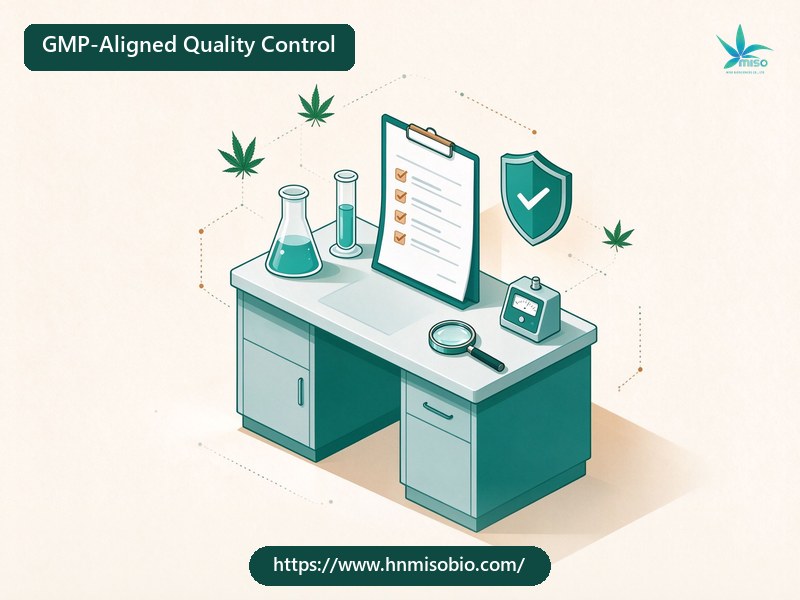
Audit the operation, ideally in person or through a virtual facility walk-through. Look for GMP-aligned production areas, documented cleaning and changeover procedures, controlled storage, and a functioning quality management system. Willingness to show the factory, lab, and warehouse is itself a strong signal; reluctance to do so usually means there is something to hide.
Finally, judge responsiveness. Do technical questions reach a qualified person? Are issues resolved with corrective actions rather than excuses? The best suppliers act as an extension of your R&D and quality teams — providing samples, formulation support, and documentation updates as regulations evolve.
A low price is visible on the invoice; poor quality becomes visible in returns, reformulations, and regulatory letters. Work through these seven points, request real documentation, and choose a partner whose process, transparency, and technical depth you can verify. The cheapest kilo is rarely the least expensive over the life of a product line.